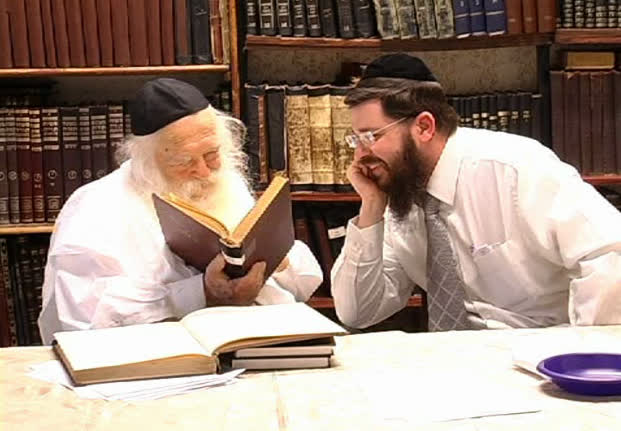
Still shattered and broken by the passing of Maran, our teacher, the Sar HaTorah and yirah, Rabban shel Yisrael, Rav Shmaryahu Yosef Chaim Kanievsky, zt”l, we spoke with one of those who was closest to him during his lifetime: Rav Uri Tiger, shlita. Rav Uri served as the official proofreader of Maran’s seforim and was privileged to enter his sacred presence at any time. He enjoyed an extraordinary closeness with the Sar HaTorah, who held him in great affection and expressed deep gratitude for the immense effort he invested in proofreading the seforim and correcting even the finest errors that entered during printing.
“We have become orphans, without a father”
“For many years, we became accustomed to not having to remain uncertain about one matter or another,” Rav Uri began, visibly shaken. “Whenever there was a doubt, we went to the Rav and asked him. Now, who will teach us understanding? Who will explain what we have heard? Whom will we ask, and where will we turn? Who will resolve our questions in learning and halachah, and who will guide us in material matters? Who will bless us with his wonderful brachos, and who will bestow his glorious blessing upon our labor— our children?”
“I returned home from the levayah and felt that the world had gone dark around me. A very bleak sense of orphanhood descended upon us. Suddenly I realized that I had never really considered what the world after Maran might look like. It is another world. There is ‘a world with Maran, shlita,’ and there is ‘a world with Maran, zt”l.’ It is a completely different situation, and I am finding it very difficult to absorb this new reality or even understand where I now find myself.”
Not a commentator—an eyewitness
We asked Rav Uri to share some of the things he had personally seen and heard in the presence of the Sar HaTorah.
“A certain rosh yeshivah called me earlier and asked me to address the bochurim in his yeshivah about Rabbeinu,” Rav Uri replied. “I told him that I am not a ‘Rav Chaim commentator.’ I cannot come and explain how great he was or how immense the void is that he left behind. What I can do is share my own personal experience: stories I saw and heard myself while spending time in that great home, and things I heard directly from Maran.”
“There was something very interesting about him. When he was asked questions about worldly matters—even complicated questions in business, medicine, or similar areas—he answered immediately, without a second thought. His response was sharp and clear, with no hesitation.”
“Someone once asked Maran: people stand here in line with their questions. Sometimes three people arrive one after another with precisely the same question and the same circumstances, yet the Rav gives each one a different answer. How does that work? Are there no rules determining when to answer one way or another?”
“Maran answered: ‘Whatever Heaven places in my mouth is what I say to those who ask.’ We indeed saw that there were no fixed rules. Even something that appeared to be an ironclad principle sometimes had exceptions. For example, Maran was accustomed to saying, ‘There is no ayin hara in Bnei Brak.’ If a resident of Bnei Brak came with a concern involving ayin hara—such as matching names in a shidduch—he would generally say there was nothing to fear. Yet there were occasions when he did express concern even for someone living in Bnei Brak. Why? There was no way to know.”
What “perhaps” meant
“In contrast to the ease and certainty with which Maran answered questions about material affairs, we saw that when the question concerned halachah, he suddenly invested much thought before responding. He opened seforim, looked carefully, studied the matter, and only then gave an answer. Some explained that in worldly matters he could employ ruach hakodesh, but in Torah and halachah, ‘It is not in Heaven,’ and therefore the issue demanded deeper thought.”
“Several people complained to me about replies they had received from Rav Chaim to letters containing Torah and halachic questions. They would present one side or another of a halachic doubt, and Rabbeinu might answer, ‘Perhaps,’ ‘Perhaps not,’ ‘It may be so,’ or ‘Maybe.’ One person argued that ‘perhaps’ was not really an answer. If he had asked the question, he already knew that it might be so and might not be so—what, then, had Maran answered?”
“I told him that his surprise showed that he did not understand who Rav Chaim was. If Rav Chaim wrote ‘perhaps,’ it meant that he had reviewed the entire Bavli, Yerushalmi, Sifra, Sifrei, and all the Rishonim, and had not found anywhere in Torah a statement of Chazal or a Rishon that contradicted the suggestion. Therefore, perhaps the observation was correct. Had there been even one statement of Chazal or one Rishon against it, it would already have been ‘impossible.’”
“One must then examine why Maran wrote ‘perhaps it is so’: upon what did he base that inclination, and why did his judgment lean in that direction?”
SELECTIVE MEMORY
Remembering a mission of chesed
“Those who frequented Maran’s home knew that he prayed three times each day to forget everything unrelated to Torah and Torah study. Throughout the day he heard stories and questions about worldly affairs, and he feared that this information would occupy space in his mind and, chalilah, diminish his capacity to retain and remember Torah. He therefore prayed to forget whatever did not concern Torah—and those prayers, too, were answered.”
“Once I asked Maran to speak to a particular person on my behalf concerning an act of chesed. Maran readily agreed to do me this favor and said he would approach the person about the matter.”
“Three or four days later, I arrived just as Maran was leaving Minchah at Lederman. He generally noticed nothing beyond his own four amos, but now, very unusually, he spotted me from a distance. The moment he saw me, he said, ‘I carried out my mission.’ I could see that an enormous weight had been lifted from him. He had needed to remember this request for me and had been very worried that he might forget. Even in a matter of chesed that he strained to remember, he feared forgetting. But Torah he remembered even after ninety years and never forgot.”
AN UNUSUAL PROMISE
“The Rav is promising me?”
“When I was a young avreich, my first son was born, baruch Hashem. Several years then passed without another child, and the matter began to trouble us. We began consulting doctors. On one occasion I told Maran that years had passed since the birth of our first son and that I did not know why we had not been blessed with more children.”
“Maran immediately answered: ‘I know why! Because you are growing a forelock. Cut off the forelock, and I promise that you will soon be blessed with a child.’”
“I was stunned. ‘The Rav is promising me?’ I asked in disbelief. This was highly unusual. Maran would normally give a brachah, but he rarely made promises. Here, he had made a direct promise. He repeated that if I removed the forelock, he promised a yeshuah. I immediately went to a barber and asked him to cut my hair so that no trace of it remained. The yeshuah came immediately.”
“Several years later, I told Maran that my wife was expecting. I said that if the baby were a boy, I would be very happy if he would serve as sandak and remain for the seudah. Maran said that he came for sandakaos but did not remain for bris meals. I tried to persuade him. ‘The Rav knows me; I am like a member of the house. Perhaps in my case the Rav could remain for at least a few minutes.’ Suddenly Maran said, ‘You know what? In the end, it will be a girl altogether.’ Needless to say, that is exactly what happened.”
A BLESSING FROM HIS FATHER
The chassan who was told, “Have a complete recovery”
“When I was a young avreich, I once took my son to a playground on Shabbos afternoon so that my wife could rest while I watched him outside. I sat on a bench beside a man I did not know. He told me that he was involved in medical chesed at Shaare Zedek and then shared an astonishing story.”
“More than fifteen years earlier, while the holy Steipler was still alive, this man had gone to him on the day of his wedding to receive a blessing. Because the Steipler was very hard of hearing, visitors wrote their requests in large letters on slips of paper, and he answered in a correspondingly loud voice.”
“The chassan wrote: ‘I am getting married today and request a blessing.’ The man before him had written: ‘I am ill and need a recovery.’ The Steipler read the ill man’s note and called out, ‘May you have a refuah sheleimah.’ That man happily left, and the chassan handed over his own note. The Steipler looked at it and again called out, ‘May you have a refuah sheleimah!’”
“The chassan thought the Steipler must have confused him with the previous visitor. He pointed to his note and shouted, ‘I am not sick! I am a chassan getting married today!’ But the Steipler continued to answer: ‘May you have a refuah sheleimah.’”
“He left bewildered. Weeks later, the Steipler passed away. Many years went by, and the couple was not blessed with children. The memory of that strange encounter on his wedding day remained in the husband’s mind. A friend eventually urged him to visit the Steipler’s son, Rav Chaim Kanievsky, and tell him what had happened.”
“He traveled to Bnei Brak, waited in line, and told Rav Chaim the entire story, including the fact that he and his wife had not yet been blessed with children. Rav Chaim became emotional, struck the shtender firmly with his hand, and declared: ‘If my father said that you will have a refuah sheleimah, then you will certainly have a refuah sheleimah.’”
“The man sitting beside me on the playground pointed to one of the children playing near my son and said, ‘Do you see that sweet child? He is the fruit of the blessings of the Steipler and his son, Rav Chaim.’”
A MAN OF TRUTH
Not even an unnecessary date could be inaccurate
“Maran was extremely careful that everything he and those around him said should be truthful and exact, without exaggeration or deviation from reality.”
“I once asked him to write a letter of recommendation concerning a certain matter. He agreed but asked me to formulate the letter and bring it to him for his signature. I drafted it with great care, using wording that I believed the Rav would be willing to sign.”
“Maran read the entire letter and was very pleased with the wording. He asked for a pen, but then noticed the date. The letter said Monday, with the appropriate date, but I had brought it after sunset. Maran said, ‘It is already Tuesday. I cannot sign a letter that contains something untrue. Correct the date, and then I will sign it.’ In such a letter the date had no practical importance, yet he would not sign a document containing even one factually incorrect detail.”
“On another occasion, I approached Maran with a difficult question. Because I live opposite Jerusalem’s Machane Yehudah market, there had been a period with several deadly attacks whose explosions shook my home. I asked whether the market was considered a place of danger because there had already been ‘a million attacks’ and who knew when another might occur. Maran stopped me immediately: ‘Not a million. There were attacks.’ On the actual question, he ruled that it was not considered a dangerous place and that there was no reason not to continue living nearby.”
ALONE AMONG NON-JEWS
Every story carried a lesson
We asked Rav Uri how to understand an apparent contrast. On the one hand, Rav Chaim was renowned for his constant diligence and immersion in learning. On the other, many stories are told that he had heard from his father, the Steipler, from his uncle the Chazon Ish, and from others.
“The stories always arose in a specific context,” Rav Uri explained. “He told them briefly and only as needed—never merely for the sake of telling a story. Usually they contained a moral lesson that he wanted people to know. At times he used a story to answer someone and demonstrate that the question had already arisen and had been faced by the great Torah leaders of an earlier generation.”
“For example, I once entered with a friend who had a difficult question. He lived with his children in a small apartment. Apart from the crowding, his neighbors were not from the same community, and the children had few playmates. He asked whether he should move somewhere more spacious where the children would also have friends.”
“Maran first gave his usual answer that a small apartment is not a disadvantage. On the contrary, he felt it was healthy for children to grow up in a small home. Regarding the lack of playmates, Maran recalled that when he was a child in Pinsk, Belarus, all the surrounding neighbors were non-Jews. ‘I also had no one to play with, so I played with my sister,’ he said. With that, he resolved the question: they could remain in the smaller home, and the children could play with one another.”
Translated from the complete Hebrew article supplied for this site. Honorifics and familiar Torah terms have been retained where they preserve the original voice.
Read the Hebrew original on Dirshu